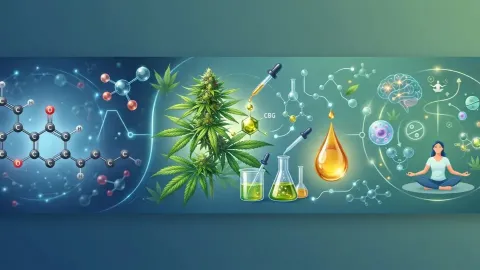
CBG, or cannabigerol, is often described as the "mother cannabinoid" of hemp. The plant uses its acid form to make THC, CBD and other cannabinoids. Long overlooked because most plants contain only very small amounts of it, CBG now shows up in the flower, resin and oils sold in shops. This guide explains what CBG is, how it differs from CBD, what research actually says about its effects, what its legal status is and how to check its content on a certificate of analysis.
The key points. CBG is a natural hemp cannabinoid that does not cause an intoxicating effect comparable to THC. In the plant, its acid form, CBGA, is converted into THCA, CBDA and CBCA, which is why usually less than 1% remains. CBG-rich flower comes from genetics whose conversion enzymes are inactive. Research on its effects in humans is still in its infancy: only one small controlled trial has been published. In France, CBG is not classified as a narcotic, but products must stay within the 0.3% THC limit, and products meant to be ingested fall under novel food status in the European Union.
CBG or cannabigerol: what this cannabinoid is, where it comes from and how it differs from CBD
Hemp produces more than a hundred cannabinoids in its trichomes, the small resin glands that cover the flowers. The best known are THC, responsible for the psychoactive effect of cannabis, and CBD, which is non-intoxicating. CBG belongs to the same family. What makes it special is its place in the plant's production chain: it sits at the very beginning, before THC and CBD.
The name "cannabigerol" comes from its chemical structure, which is close to geraniol, an aromatic compound also found in roses and geraniums. CBG was first isolated in 1964 by Israeli researchers Yehiel Gaoni and Raphael Mechoulam, the same team that identified the structure of THC that year.
The "mother" cannabinoid: how the plant makes CBG
In the trichomes, the plant combines two molecules, olivetolic acid and geranyl pyrophosphate, to form cannabigerolic acid, or CBGA. This CBGA then serves as raw material for three enzymes called synthases:
- THCA synthase, which converts CBGA into THCA, the acid form of THC;
- CBDA synthase, which converts it into CBDA, the acid form of CBD;
- CBCA synthase, which converts it into CBCA, the acid form of CBC.
In a plant where these enzymes work normally, almost all of the CBGA is converted as flowering progresses. That is why most hemp varieties contain less than 1% CBG at maturity. As with THC and CBD, the acid form dominates in fresh flower: heat, whether from combustion, vaporization or lab processing, converts CBGA into neutral CBG. This process is called decarboxylation.
Botanists classify cannabis into chemotypes according to the dominant cannabinoid:
| Chemotype | Dominant cannabinoid | Example |
|---|---|---|
| Type I | THCA | THC-rich recreational or medical cannabis |
| Type II | THCA and CBDA in similar proportions | So-called balanced varieties |
| Type III | CBDA | Most CBD flower sold in shops |
| Type IV | CBGA | CBG-rich varieties |
| Type V | Almost no cannabinoids | Some industrial hemp varieties |
How CBG-rich flower is produced
CBG-rich flower comes from a type IV plant, in which the conversion of CBGA is blocked. A study published in 2021 in the journal Genes by researchers at the company Oregon CBD showed that this CBGA dominance is inherited as a recessive trait, linked to a probably inactive variant of the THCA synthase gene. In a 2020 variety trial run by Cornell University (New York State), CBG-rich plants also had inactivated synthases, and most of the cultivars tested had a CBG to THC ratio of about 70 to 1. The researchers note that it is therefore easier to stay below the 0.3% THC limit with these plants than with CBD-rich plants.
The same trial also shows a limitation: several cultivars sold as "CBG" were not stable. Some plants from the same batch were CBG-dominant, others CBD-dominant. For buyers, this confirms that a strain name is not enough: only a batch analysis shows the actual content.
Another approach is to harvest the plant earlier, before the CBGA is fully converted. This gives more modest levels. Finally, some products are enriched with extracted or isolated CBG. In that case, the stated content no longer reflects what the plant produced naturally, and the seller should say so clearly.
CBG vs CBD: the differences at a glance
| Criterion | CBG (cannabigerol) | CBD (cannabidiol) |
|---|---|---|
| Role in the plant | Precursor: its acid form gives rise to THCA, CBDA and CBCA | End product of CBGA conversion by CBDA synthase |
| Typical content | Less than 1% in most varieties, more in type IV genetics | Main cannabinoid in the CBD flower sold in shops |
| Intoxicating effect | No, no effect comparable to THC | No, no effect comparable to THC |
| Targets studied | Alpha-2 adrenergic receptors, 5-HT1A serotonin receptors, weak action on CB1 and CB2 | Many targets, low affinity for CB1 and CB2 |
| Human research | Very limited: a first controlled trial published in 2024 | More extensive, with an approved medicine for certain rare forms of epilepsy |
| Sport (World Anti-Doping Agency) | Banned, like all cannabinoids except CBD | Allowed, the only exception on the list |
What research says about the effects of CBG
Research on CBG still relies mostly on laboratory studies in cells or animals. A review published in 2021 in the Journal of Pharmacology and Experimental Therapeutics by researchers at Pennsylvania State University summarizes this work: CBG acts in particular on alpha-2 adrenergic receptors, blocks the 5-HT1A serotonin receptor and has only a weak action on the CB1 and CB2 cannabinoid receptors. The authors conclude that these results justify clinical studies, not that they demonstrate an effect in humans.
The first controlled trial in humans was published in July 2024 in the journal Scientific Reports by a team from Washington State University and the University of California, Los Angeles. Thirty-four adults, all regular cannabis users, took either 20 mg of CBG or a placebo in two sessions one week apart, without knowing which. Participants reported less anxiety after CBG than after the placebo, with no impairment of their cognitive or motor abilities and only a slight feeling of intoxication. No improvement in mood was measured.
The authors themselves point out the limitations of this trial: a small group, participants already used to cannabis, a single dose, sessions run remotely by video call and no physiological measurements. They warn against presenting CBG as a miracle product until these results have been replicated. To date, no CBG-based medicine has been approved, and no CBG product sold in shops may claim any health effect.
Safety, driving and sport: points to watch
Safety data in humans remain scarce. CBG is metabolized by the liver, like CBD, and an interaction with certain medications cannot be ruled out. If you are on medical treatment, pregnant or breastfeeding, it is wise to ask a doctor or pharmacist before using it.
Behind the wheel. Roadside drug tests do not look for CBG itself. However, CBG flower or resin almost always contains traces of THC, and THC is exactly what the saliva test detects. In France, driving after using narcotics is a criminal offense, regardless of the amount detected. A product that complies with the 0.3% limit therefore does not guarantee a negative test.
In competitive sport. The World Anti-Doping Agency's Prohibited List bans all natural and synthetic cannabinoids, with the sole exception of CBD. Athletes subject to anti-doping testing should therefore avoid CBG products, as well as CBD products that contain CBG.
The legal status of CBG in France and the European Union
CBG is not classified as a narcotic in France. Products containing it follow the same rules as other hemp products: they must come from varieties listed in the EU catalogue and stay within the 0.3% THC limit set by the decree of December 30, 2021. Since the Conseil d'État (France's highest administrative court) ruling of December 29, 2022, which overturned the ban on selling raw flowers and leaves, CBG flower can be sold in France on the same basis as CBD flower.
The status also depends on the product form:
- Products meant to be ingested (food oils, capsules, gummies): in the European Union, hemp extracts containing cannabinoids fall under the Novel Food Regulation. They need authorization before they can be sold as food, and no CBD or CBG extract had been authorized as of this article's publication date.
- Cosmetics: cannabigerol has been listed since 2021 in CosIng, the EU database of cosmetic ingredients, with the function "skin conditioning".
- Flower and resin: these are sold as hemp products and must not carry any health claims.
Be careful not to confuse CBG with semi-synthetic molecules such as HHC, HHCO or HHCP. CBG is produced naturally by the plant, whereas these molecules are obtained through chemical conversion. They have been classified as narcotics in France since June 2023.
Reading CBG content on a certificate of analysis
On a certificate of analysis (COA), CBG usually appears on two lines: neutral CBG and CBGA, its acid form. As with THC and CBD, the useful value is total CBG, which accounts for the mass lost during decarboxylation:
Total CBG = CBG + 0.878 × CBGA
The 0.878 factor is the ratio between the mass of CBG and that of CBGA. A flower tested at 0.5% CBG and 10% CBGA therefore contains about 9.3% total CBG. The same calculation applies to THC, and total THC is the value to compare with the 0.3% limit. Our total THC calculator does this calculation for you, and the guide total THC or delta-9-THC explains why the difference matters.
An example from our database shows why you should read the lab report rather than the seller's product page. For the Charas CBG Hash by CBDNOL resin, the product page claims 35% CBG. The report from the Fuczik laboratory in Vienna shows 43.51% total CBG, 3.65% total CBD and 0.1% total THC. However, this report is dated October 6, 2021: the batch sold today may have a different composition.
Before buying a CBG product, check:
- that the report covers the batch being sold, with a batch or sample number and a recent date;
- that the laboratory can be identified, with its name, address and, ideally, an accreditation;
- the CBGA line, without which total CBG cannot be calculated;
- total THC, which must stay below 0.3%;
- any enrichment with extracted CBG, which the seller must disclose.
Our read a certificate of analysis tool and the guide how to read a CBD certificate of analysis explain each line of a report in detail.
Flower, resin, oils: the forms CBG comes in
CBG is now available in the same forms as CBD:
- CBG flower: grown from type IV genetics, it looks like CBD flower. Its aroma depends on the terpenes of the variety, not on CBG itself, which has almost no smell. Since CBG is concentrated in the trichomes, our article on cannabis trichomes helps you judge the quality of a flower.
- CBG resin: made by sieving or pressing trichomes, it is listed with CBD resin in our comparison tool.
- Oils: often blends of CBD and CBG. Their status depends on the intended use, cosmetic or food, as explained above.
CBG products are rarer than CBD products, and their prices vary widely. To compare two offers, always work out the price per gram and relate it to the actual content measured by the lab, as explained in our guide to comparing prices per gram.
FAQ · 6 questions
Frequently asked questions about CBG
Short, clear answers with no health claims.
Does CBG get you high?
No. CBG does not cause an intoxicating effect comparable to THC. In the first controlled human trial, published in 2024, participants reported feeling only slightly intoxicated, with no impairment of their cognitive or motor abilities.
What is the difference between CBD and CBG?
CBG is the precursor: the plant converts its acid form, CBGA, into CBDA (the acid form of CBD), as well as into THCA and CBCA. CBD is therefore a product of CBG conversion. Neither is intoxicating, but CBG has been studied far less, and unlike CBD it is banned in sport.
Is CBG legal in France?
Yes. CBG is not classified as a narcotic. Products must come from authorized hemp varieties and contain no more than 0.3% THC. Products meant to be ingested also fall under the EU Novel Food Regulation.
Can CBG cause a positive saliva test?
Saliva tests do not look for CBG, they look for THC. However, CBG flower or resin almost always contains traces of THC. A positive test is therefore possible, and driving after using narcotics is a criminal offense in France.
Can athletes use CBG?
No, not in competitions subject to anti-doping rules. The World Anti-Doping Agency bans all natural and synthetic cannabinoids, with the sole exception of CBD.
How do you calculate total CBG on a certificate of analysis?
Add neutral CBG to CBGA multiplied by 0.878: Total CBG = CBG + 0.878 × CBGA. Also check that the report covers the batch being sold and that total THC stays below 0.3%.
This article is provided for general information only. It does not constitute medical or legal advice. CBG products are not medicines and may not claim any health effect. Applicable rules may change: check the regulations in force in your country.
Big CBD Product is an independent, non-profit comparison site. Our answers follow a public method: verified data, dated reviews and no disguised advertising. See our method